
Effingham Projected Versus Actual Release
A projected date is a current calculation. It is not a court promise or a guaranteed hour of departure. IDOC uses the exact label Projected Parole Date for the expected transition from prison to parole or mandatory supervised release based on the sentence and credits then known. Projected Discharge Date generally looks farther ahead to the end of the state sentence and supervision.
An actual Parole Date records a transition that occurred. It does not mean final discharge. County pretrial detainees usually have no comparable fixed date because release depends on a court order and processing. A county sentence also does not acquire an IDOC projected-parole field unless the person enters IDOC custody.
Find an Effingham Release Date
First identify who holds the person and what sentence applies. The Illinois Department of Corrections search covers state custody and parole records. It does not calculate a date for every Effingham County Jail booking. Local dates come from the sentencing order, jail credit, applicable law, and the sheriff's operational calculation.
- Use the IDOC number when known. A name search requires comparison of birth date, physical details, county, and sentence history.
- Open the profile and read
Offender StatusandLocationbefore any date. - Review the admission, release, and discharge block. Copy each label exactly.
- Read every sentence row. One row marked discharged may coexist with another active sentence.
- For a county sentence, obtain the signed order and ask jail records about the existing calculation.
- If written state confirmation is needed, contact IDOC Public Information at 1301 Concordia Court, P.O. Box 19277, Springfield, IL 62794-9277.
The official IDOC example record displays both projected labels in their proper context.
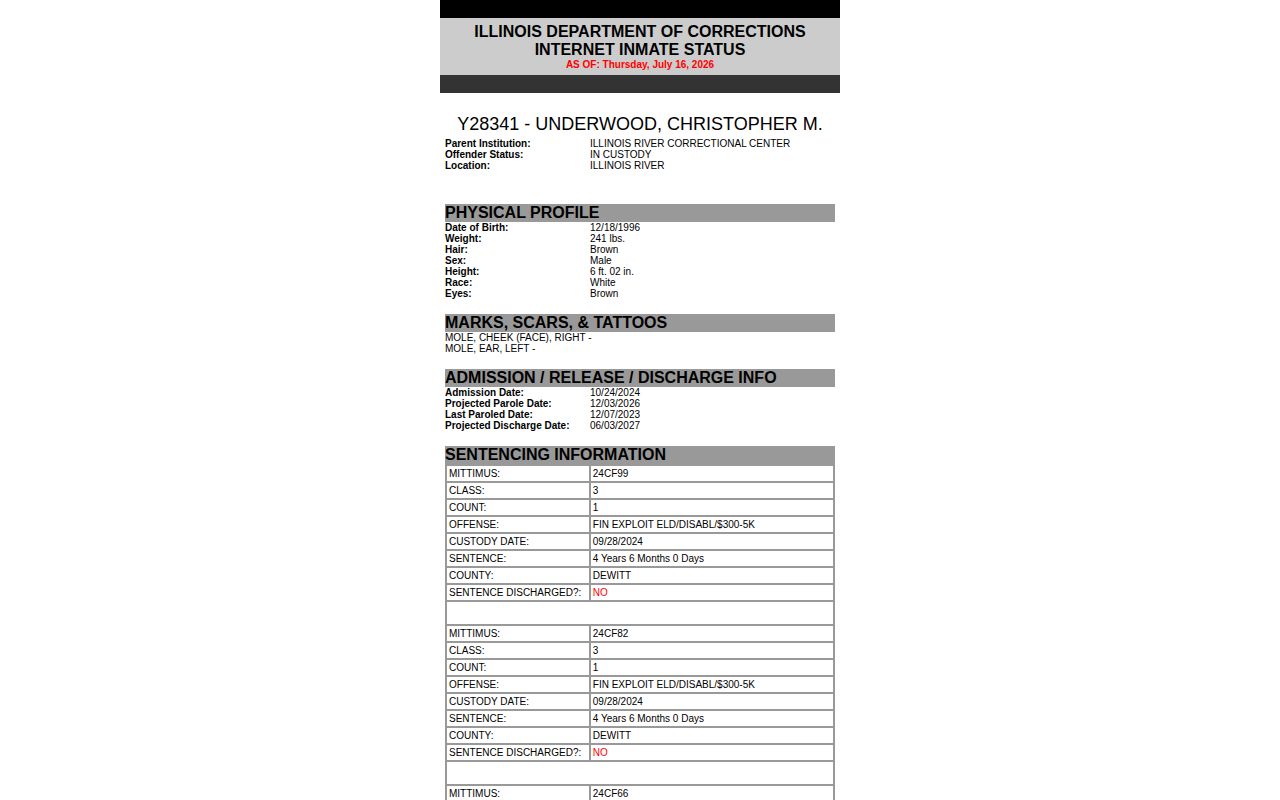
The record shows why the field name must travel with the date. A projected parole date and projected discharge date answer different questions.
IDOC profiles also include the parent institution, current status, location, admission and release data, and sentencing rows. Those fields establish scope. A county name in a sentence row does not mean the person remains in that county jail. Likewise, a parole-district location is a supervision label, not a prison address.
When a name search returns several people, do not select by photograph alone. Compare the IDOC number, middle initial, date of birth, physical profile, custody date, offense, and sentencing county. Record the exact search terms used. If identity stays uncertain, request written verification instead of assigning a projected date to the wrong person.
Illinois Credit Shapes Effingham Dates
730 ILCS 5/3-6-3 governs Illinois sentence credit. The rule depends on the offense, offense date, sentence, and eligibility. Certain murder and terrorism categories receive no sentence credit and effectively require 100 percent. Listed serious offenses are capped at 4.5 credit days per month, often described as an 85-percent floor. Other listed categories use a 75-percent framework. It is inaccurate to say all Illinois prisoners serve 85 percent.
The IDOC Director may award discretionary earned sentence credit within statutory limits. Eligible programs can also yield credit for defined substance-use, education, correctional industry, work-release, behavior, life-skills, or reentry work. Degree credits have separate rules. Statutory floors still apply, and some sex-offense sentences have treatment-related restrictions.
Discretionary earned credit can reach up to 180 days for terms under five years and up to 365 days for terms of five years or more, subject to eligibility and the required confinement period. Qualifying county-jail time may count toward that confinement rule. Pretrial programming credit can also depend on what the sentencing order awards. These are limits and pathways, not automatic awards for every person.
Credits may not push a sentence below its applicable statutory floor. Disciplinary findings can cause loss, and later action can restore credit. For that reason, two records saved months apart may show different projections without either screenshot having been fabricated.
- Sentence credit
- Time credited against a term under the governing statute.
- Earned credit
- Credit tied to eligibility, conduct, or approved programming.
- Detainer
- A request or legal basis for another authority to hold or receive a person.
- Projected parole date
- IDOC's current calculation for leaving prison for supervised release.
Why Effingham Release Dates Move
IDOC projections are recalculated when the facts used in the calculation change. Credits can be awarded, revoked, or restored. New sentence data and corrections can alter the term. Consecutive or concurrent treatment of multiple sentences also matters. A return after a supervision violation may require a new calculation.
| Change | Possible effect | Best record |
|---|---|---|
| Earned credit | May advance a projection within statutory limits | IDOC calculation and statute |
| Credit loss or restoration | May move the date later or earlier | IDOC disciplinary and calculation record |
| New or corrected sentence | Can change the term and date | Signed court order and IDOC profile |
| Concurrent or consecutive terms | Changes how terms combine | Sentencing orders |
| Violation return | May require recalculation | PRB result and IDOC record |
| Other-agency hold | May prevent community release | Movement destination and holding authority |
House Bill 3026 changes effective in 2024 required IDOC to recalculate MSR dates for qualifying people, and IDOC warned that added credit could significantly advance some dates. That history reinforces the need to use the current record rather than an old screenshot.
Confirm Effingham Release Events
A projection should be paired with a later event. Illinois VINE may report a custody change from a participating agency, but an out-of-custody event may also reflect transfer. Use the VINELink Release Check for a named record and alerts, then compare the agency, timestamp, court authority, and destination.
For Effingham County Jail, call jail and booking at 217-342-3866 and request the existing release or movement record if historical proof is needed. For IDOC, read the current profile and seek written confirmation when the distinction between parole, transfer, and final discharge matters.
Effingham County Sentence Dates
The Effingham County site publishes no jail release-date calculator and no local good-time policy. A county-only sentence must therefore be traced through the court and sheriff. Obtain the signed sentencing order, not just a short docket line. Check the imposed term, jail-credit entry, start date, and any later amended order. Then ask the jail for the existing calculation or record that shows when processing is expected.
A court date does not always equal the time someone walks out. Staff must check active holds and release authority, and another county or agency may receive the person. Effingham County Jail also houses people for area counties as needed. In those cases, the end of a stay in Effingham can be a return to the originating county rather than community release.
No official source supplies a standard release hour, weekend rule, public waiting area, or processing timetable for this jail. Do not estimate one. A family member seeking a pickup time should rely on current instructions from jail staff after the release authority is confirmed.
The sheriff release record should identify the actual date and time, recorded authority or reason, and destination when those fields exist. Ask for the movement log as well. That record can separate a door release from IDOC transport, return to another county, or handoff to another lawful custodian. The distinction matters more than the fact that the person disappeared from a current search.
Effingham Pretrial Release Has No Projection
A pretrial detainee has not begun serving an IDOC prison term merely because a charge is pending. Release can turn on a signed detention or release order, changed conditions, dismissal, another case, or a hold. The Effingham criminal docket can show the legal event, while the sheriff's movement record shows when the facility acted and where the person went.
Do not convert a scheduled hearing into a release date. The judge may continue the matter or issue an order that does not lead to immediate community release. Likewise, a dismissal in one case does not defeat an unrelated warrant or detainer. Read the signed order and verify physical movement.
Effingham Parole and Discharge Dates
Illinois uses parole language for more than one legal path. Old-law indeterminate cases and qualifying youthful cases can involve Prisoner Review Board votes. Most people under the later determinate system instead leave after serving the term as calculated by IDOC, then enter MSR. PRB sets conditions but does not choose the sentence-satisfaction date for every such person.
A status of PAROLE, a parole-district location, and an actual Parole Date support physical release from an institution into state supervision. They do not show that all state control has ended. A future projected discharge date marks a later expected milestone. For finality, inspect all sentence rows and seek the PRB final-discharge order or IDOC written verification where needed.
Old screenshots can mislead because sentence credits, violation outcomes, and corrections change calculations. Save the retrieval date and the agency's exact field labels. Never relabel a projected date as an actual release.
Parole hearing dates also should not be mistaken for projected release dates. Old-law and qualifying youthful cases may have a Prisoner Review Board calendar and decision record, but a listed hearing does not guarantee a grant. A denial may include a later set date. A grant begins a supervised phase unless a separate final discharge applies.
For most determinate cases, IDOC's calculation remains the key source. PRB may set conditions or decide a violation, yet it does not vote on ordinary sentence satisfaction for every prisoner. Keeping those roles apart prevents a hearing calendar from replacing the current IDOC profile.
When dates conflict, seek the newest official calculation and the signed court documents behind it. Preserve both the retrieval date and source.